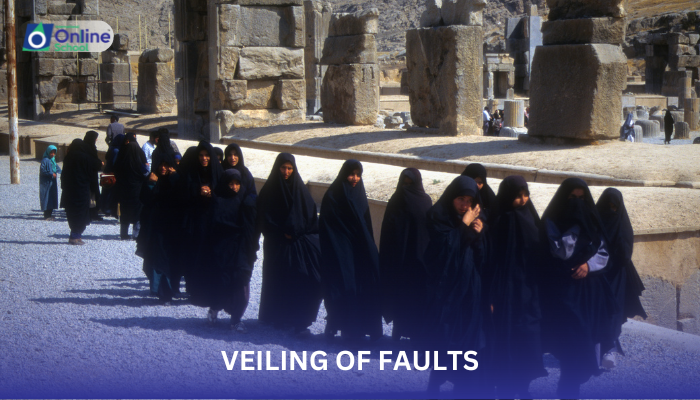
The meaning of veiling is: 'to cover up one's faults.' The religion Islam teaches us that we should not try to find fault of anyone. If we come to know someone's fault, we should try to hide it. Neither should we try to reveal it nor should we taunt him about it. Allah Almighty has forbidden in the Holy Quran to find faults of people.
Allah says:
وَلا تَجَسَّسُوا
Translation:
''And do not be curious (to find out faults of others).'' (Surah Al-Hujurat: 12)
In the same way, it has been declared as a grave sin to point out someone's faults and taunting him. Veiling of faults is an attribute of Allah. The Holy Prophet described covering the faults of others as a great virtue.
The Holy Prophet said:
''Whoever screened a Muslim, Allah will screen him on the Day of Resurrection.'' (Sahih al- Bukhari: 2442)
If someone has seen a bad act of another person, then he should remain silent and refrain from communicating it to others, but if it is a collective crime that causes individual or collective harm to the members of the society, then, in the collective interest of society, taking care of such act and informing the concerned people is also valued and appreciated by Islam. Covering up is not only of the faults of another person, but the covering up of one's own faults is also included in the cover up.
The Holy Prophet said:
''All the sins of my Ummah (Believers) will be forgiven except those who commit a sin openly or disclose their sins to the people.''
An example of such disclosure is that a person commits a sin at night and though Allah screens it from the public, then he comes in the morning, and says, 'O so-and-so, I did such-and-such (evil) deed yesterday,' though he spent his night screened by his Lord (none knowing about his sin) and in the morning he removes Allah's screen from himself. (Sahih al-Bukhari: 6069)
When the Holy Prophet ever wanted to correct people, he would speak without mentioning the other person's name. Sometimes he would say what has happened to people that they say like this and do like this. People used to correct themselves with that much.
Once the Holy Prophet came to the pulpit and called out to the people in a loud voice and said:
''Do not harm the Muslims, nor revile them, nor spy on them to expose their secrets. For indeed whoever tries to expose his Muslims brother's secrets, Allah exposes his secrets wide open.'' (Jami at-Tirmidhi: 2032)
Hazrat Umar Farooq came to know about an old man that he drinks alcohol. He did not tell anyone about his defect. Then after some time the man came to his service, and he said that I had abandoned this practice and given up alcohol.
In the present era of advanced media, veiling on faults is generally not considered. Whatever a person sees is considered obligatory to be passed on immediately to other people and groups without research and ignoring the teachings of veiling of faults. Thus he becomes involved in two types of sins. One sin is to spread false news and the other sin is to reveal the faults of others. It is also necessary to cover faults of others in this era of advanced communication and mobile phones so that these things will prove to be a blessing for us rather than a disaster.
There are many worldly and hereafter disadvantages of not adopting the attribute of veiling of faults. Anarchy spreads in the society. As hatred grows, an atmosphere of enmity grows. If the faults of others are covered up, the feelings of mutual cooperation and understanding are developed. When bad conversations and faults are being expressed, then evil grows in the society and if the talk of evil is overshadowed, then all evils eradicate from the society. When Allah Almighty covers our faults and forgives us for them then we should also adopt this attribute to cover up the faults of others and should forgive others so that the feelings of mutual love and cooperation develop and the society becomes a cradle of peace.
